Small by design
Learning has always happened in small teams where students are known by name.
About
How our school grew from a community idea into a place where every student is known by name.
Ozark Middle School began as a community idea. A group of neighbors in the Lake of the Ozarks region, Missouri set out to build a school where children could learn in close-knit teams, where the questions worth asking came as easily from the cove as from a textbook, and where every student would be greeted by name.
From the start, the lake itself became the heart of the curriculum. The water became a source of inquiry, the woods a place for creativity, and the shoreline an invitation to service. Over the decades, the school grew classrooms, studios, and labs around that simple idea, while holding on to the belief that a school is mostly a place where people learn to take care of one another.
1987
A community planning group sketches a grades 6–8 school organized around small learning teams.
1989
The school opens with 312 students, a library commons, science courtyard, and multipurpose gym.
1998
An outdoor-learning boardwalk and water-quality program are added.
2007
A black-box theater, rehearsal rooms, and visual-arts studio open.
2016
Fabrication, robotics, media production, and one-to-one digital learning become part of the program.
2023
The advisory program is redesigned around belonging, study habits, service, and student goal-setting.
2026
The school launches its redesigned website to better connect students, families, and staff.
Learning has always happened in small teams where students are known by name.
In every era, the school has treated the water and woods as a classroom.
Stewardship of the campus and shoreline has been part of the story from the start.
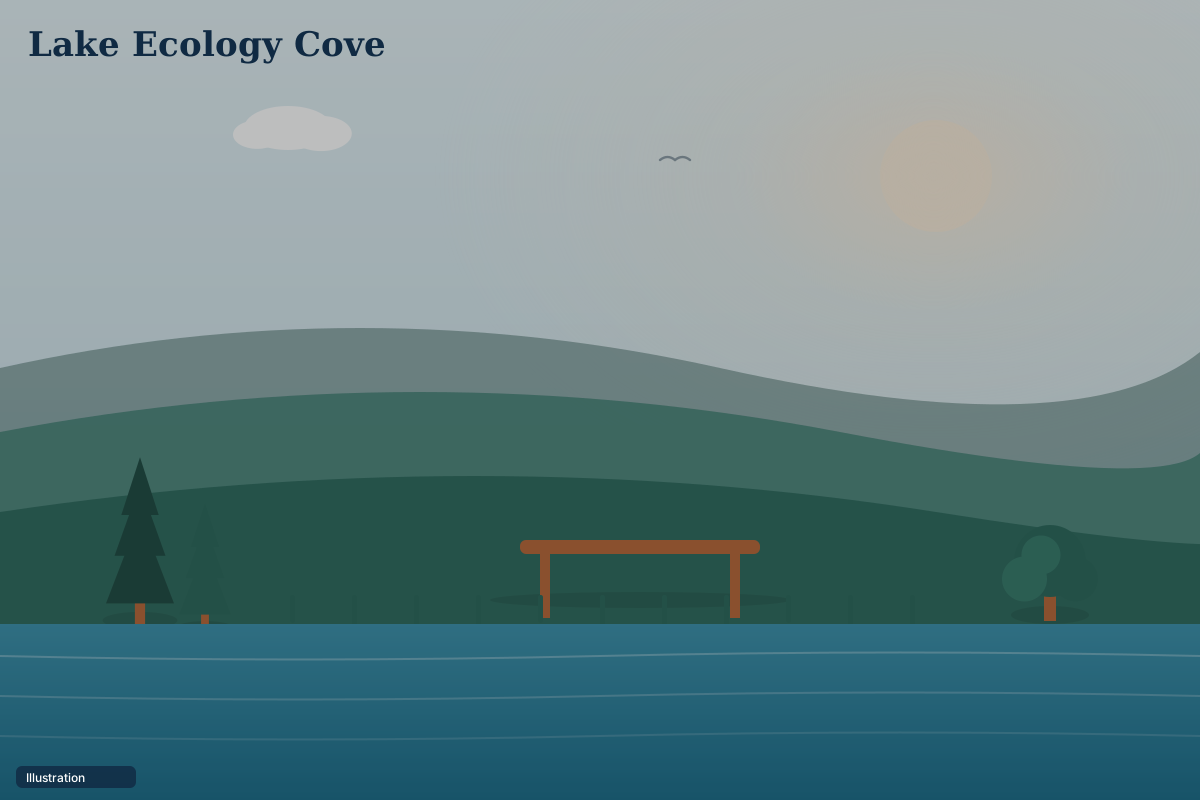
The cove behind the school is its largest classroom. Sixth graders sample water and sketch what lives along the boardwalk; seventh graders trace how the seasons change the shoreline; eighth graders bring their questions to a capstone they share with the whole community. The lake is treated as something to study, to enjoy, and to protect — all at once.